
This is the first of seven articles that chronicle the details of this precious bird’s healing process.
In sharing this information with you I ask you to acknowledge along with me that parrots are intelligent, sentient and self-aware individuals capable of feeling a wide range of human-like emotions.
x
Using A Holistic Approach for Healing Feather Destruction Habits
x
x
Introducing Elvis
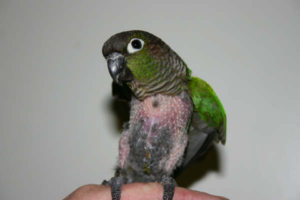
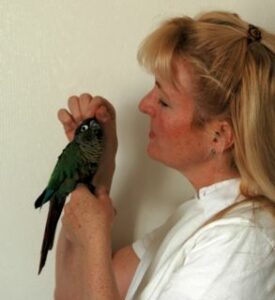
One afternoon my phone rang. It was a woman wanting to give me her bird. After determining that she would not work with him herself, I agreed to meet Elvis. This six year-old Green Cheek conure was being re-homed because he had developed the stress-induced habit of plucking his feathers.
Lack of Early Training
Elvis had been bought by this woman (five and a half years earlier) as a gift for her eight year-old daughter. Being a newly weaned hand fed baby he was like a blank slate, eager to learn and explore. From the very beginning Elvis was allowed to do what ever he wanted. This included ripping holes in clothing and destroying earrings or jewelry as he sat on a shoulder. This well intended family, and his young caretaker, had no idea how healthy and important it is to set certain boundaries with a curious young parrot.
x
Identifying Stressors
Over the six years Elvis had been with this family there had been many changes. One stress that clearly pushed him past his coping threshold was when his companion of a few years, a Green Cheek hen, died unexpectedly while the pair was being boarded. During the very next vacation this family took Elvis began pulling out his feathers.
A Dependent Relationship
In an effort to give Elvis more appropriate, healthy, stimulation this woman began taking him to work with her. He had three cages in three different locations he could reside in. One was at the office, one was at home, and another was at home outside on the deck overlooking a scenic pine forest.
x
However, if either this woman or her daughter had to leave for a day or changed their schedule with Elvis, he plucked. The regular vacations this family took weighed heavily on this small bird.
x
This woman decided that spending more time with Elvis was the answer. So she carried him on her shoulder more and engaged him in play. Her daughter was encouraged to do the same. However this young girl, now 14, had acquired new interests. And, sadly for Elvis, spending time with him didn’t fit in with her other activities. His plucking continued.
x
x
He Lacked Self Confidencex
Elvis had been systematically plucking out all his feathers every time he was left alone or there was a change in the schedule he expected. This pattern occurred repeatedly for 2 years.
x
x
Hello Elvis
I met this woman and Elvis at her office. He took to me right away. As Elvis climbed around on my knee she told me he liked to bite. Fortunately he had been trained to step up onto a perch or pencil. With this new piece of information I kept Elvis off my shoulder and began talking with him about needing to come and live with me. He appeared enamored. Although this woman could not provide Elvis what he needed, she clearly was concerned for his welfare.
x
For the next article in this series, follow this link:
x
x
This article originally appeared in its entirety in the August 2007, issue #115, of Parrots magazine. Subscriptions to Parrots magazine are available on-line at www.parrotmag.com .
x
Did this post provide you helpful information? Do yo have questions? Please send us a comment.
x
x