
This blog contains excerpts from my column, ‘The Holistic Parrot’, that appears in the April 2011, #159 issue of Parrots magazine.
** Information update, since this blog was originally written and posted I have created a ‘Balanced Exotic Avian Food Plan’. When feeding the foods in this plan avian vitamin supplements are completely unnecessary, and can actually be harmful for your birds. Keep reading to learn more.**
Lack of Balance
Malnutrition is caused by an imbalance of nutrients – deficiencies or excesses. When creating diet and nutritional plans for parrots it’s essential to ensure a balance of nutrients is provided. Providing parrots and finches balanced nutrition is more important than the other companion animals I have worked with.
Caution: Fat Soluble Vitamins
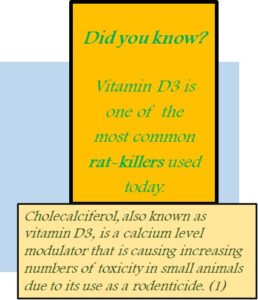
In order to prevent vitamin toxicity in your birds you must monitor levels of vitamins A, D3 and C in your bird’s diet that are in formulated pellet diets and supplements. Vitamins A and D3 are fat-soluble vitamins. They are dispersed and stored in fat, any excesses remain in the body and can cause toxicity problems (hypervitaminosis).
x
xx
x
Use caution when using vitamin and mineral supplements that contain these nutrients educate yourself – read the label, determine ingredients and their amounts, do the math, identify the amount of vitamin A, D3, C your bird will be receiving. If this information is not on the label contact the manufacturer.
x
Clearly, more research in avian nutrition is needed.
x
**********************************************************
Minimum Recommended Daily Allowances
For Psittacines minimum maximum
Vitamin A activity 9 total), IU/kg 8000 none shown
Vitamin D3, ICU/kg 500 2000
From the AAFCO (Association of American Feed Control Officials), Nutrition Expert Panel Review, New Rules for feeding pet birds. ICU is International Chick Units, a measurement used to distinguish D3 from D2 in poultry and avian nutrition.
x
Remember, the companies that make the pelleted bird diets also establish these dietary allowances.
**********************************************************
Was this blog helpful? Do you have any other questions about this topic? Please send a comment.
x
Read an account of a an avian veterinarian’s case report that discusses hypervitaminosis A and D3 in a Moluccan cockatoo and Blue and Gold macaw. Learn how to avoid hypervitaminosis A and D3
Learn how vitamin C supplementation may contribute to iron storage disease.
For the full details of these topics and more about over-supplementation malnutrition see the complete published version of this column.
x
For the complete published version of this column visit Parrots magazine.
x
Next month the May ‘The Holistic Parrot’ column will answer questions from a new avian caretaker.
REFERENCES:
- DeClementi C, Sobczak BR. Common Rodenticide Toxicoses in Small Animals. Vet Clin North Am Small Anim Pract. 2018 Nov;48(6):1027-1038. doi: 10.1016/j.cvsm.2018.06.006. Epub 2018 Aug 31. PMID: 30173927. https://pubmed.ncbi.nlm.nih.gov/30173927/
x



Pingback: What is Avian Malnutrition? - Best Bird Food Ever